
Allentown area tree risk
Start with what you can see safely from the ground.
You do not need to stand under a damaged limb or climb a tree to notice warning signs. If a tree is near a house, driveway, sidewalk, street, fence, or utility line, visible changes deserve attention.
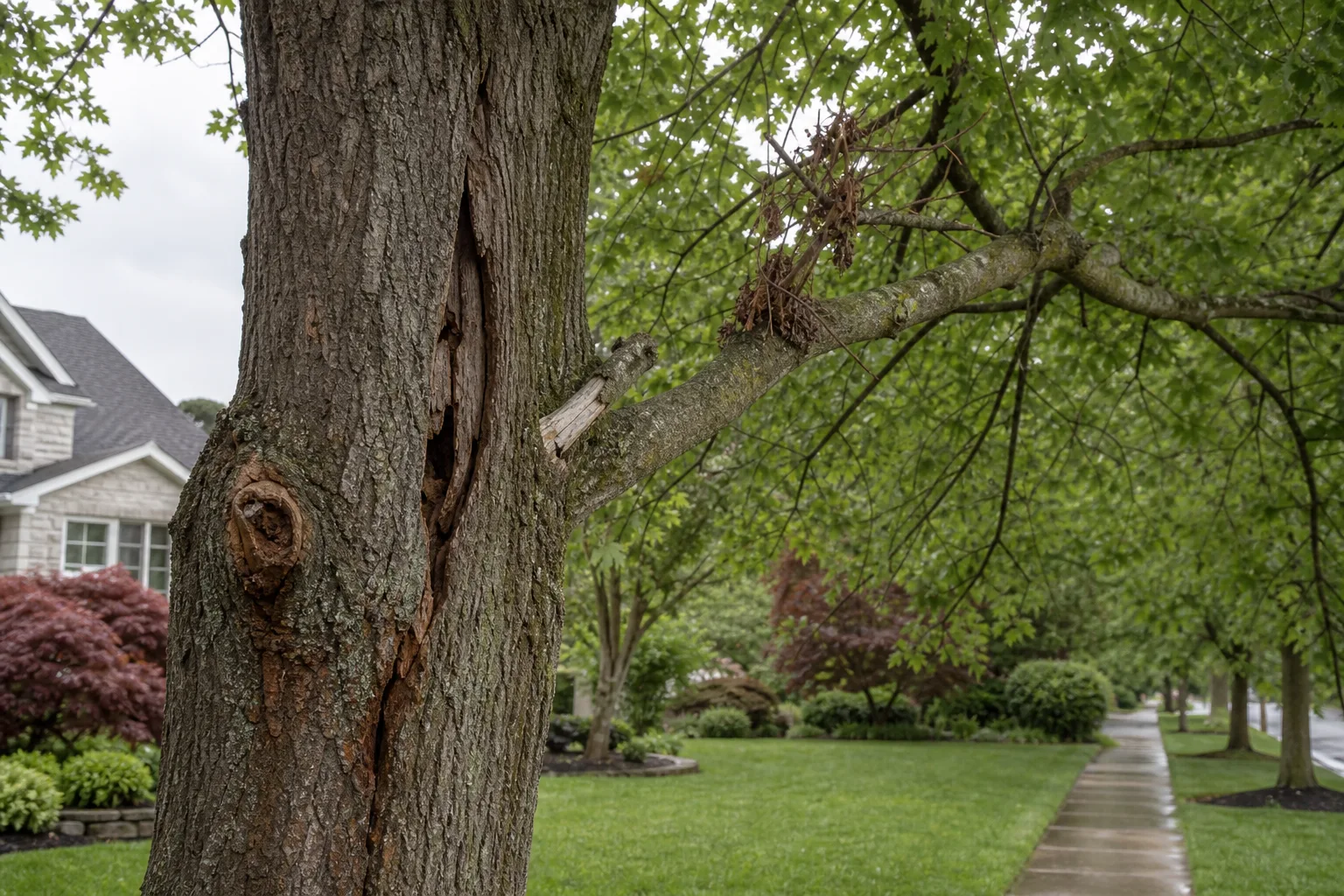
Warning signs to watch for
- Large dead limbs: Deadwood can break without much warning, especially after wind or heavy rain.
- Cracks or split trunks: Splits in the main stem or major unions can point to structural weakness.
- Sudden lean: A new lean, raised soil, or exposed roots should be taken seriously.
- Fungus or decay: Mushrooms, soft wood, cavities, or decay near the base may indicate internal weakness.
- Hanging branches: Broken limbs suspended in the canopy are a common reason to request urgent help.
- Storm damage: Cracked limbs, torn branches, and shifted trees can change risk quickly.
What to do next
Keep distance
Stay out from under damaged limbs and keep people, vehicles, and pets away from the target area.
Take safe photos
If safe, take photos from the ground showing the whole tree, trunk base, problem area, and nearby structures.
Choose the service
Use assessment for uncertainty, pruning for correctable limbs, removal for trees that cannot be retained, and emergency service for urgent hazards.
Safety note for wires
If a tree or limb is touching wires, stay away and contact the utility or emergency services when there is immediate danger. Do not try to move branches near wires.
Dangerous tree FAQs
What are signs that a tree may be dangerous?
Warning signs include large dead limbs, cracks, split trunks, fungus near the base, sudden lean, root movement, hanging branches, cavities, and storm damage near homes, driveways, or walkways.
Is a leaning tree always dangerous?
Not always. A long-standing lean may be stable, but a sudden lean, soil movement, exposed roots, or a lean toward a target should be assessed promptly.
When should I request emergency tree service?
Request emergency tree service for hanging limbs, blocked access, split trunks, storm-damaged branches on structures, or trees touching wires. Stay away from trees or limbs near wires.